Beyond Copenhagen on a day trip
To expand our Copenhagen experience, Mr. TWS and I decided to take a nine-hour day trip from Copenhagen going north to Helsingør and then across the Øresund strait to the cities of Lund and Malmö in Sweden. Each of these places can be easily reached from the city on your own by car or public transportation, but we chose an organized tour arranged by Get Your Guide to be able to combine all three places leaving the local tour company to handle the logistics.
Our tour took us by coach to Helsingør, then by car ferry to Sweden where we were driven on the same coach south to Lund, then to Malmö, and back to Copenhagen via the Øresund Bridge.
Kronborg Castle in Helsingør
Our first stop was Helsingør, Denmark, where some in our group chose to spend time in the city center and harbor district to explore its history and culture. An interesting fact is that Helsingør was designated a European Green Capital in 2024 for its consistent record of high environmental standards. We chose to walk to Kronborg Castle, the inspiration for the castle in Shakespeare’s Hamlet (known as Elsinore, the English version of Helsingør).
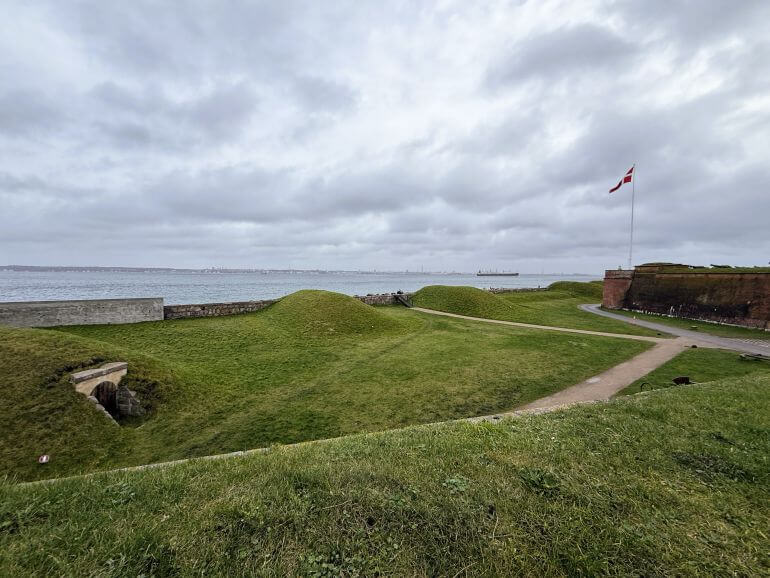
View from the grounds of Kronborg Castle in Denmark across Øresund to Sweden
Kronborg Castle, a UNESCO World Heritage site for its historical and architectural (Renaissance) significance, was built by Frederik II as a showcase of his power at a strategic location on a point reaching out into Øresund (the strait between Denmark and Sweden) at its narrowest spot (as shown in the photo above).
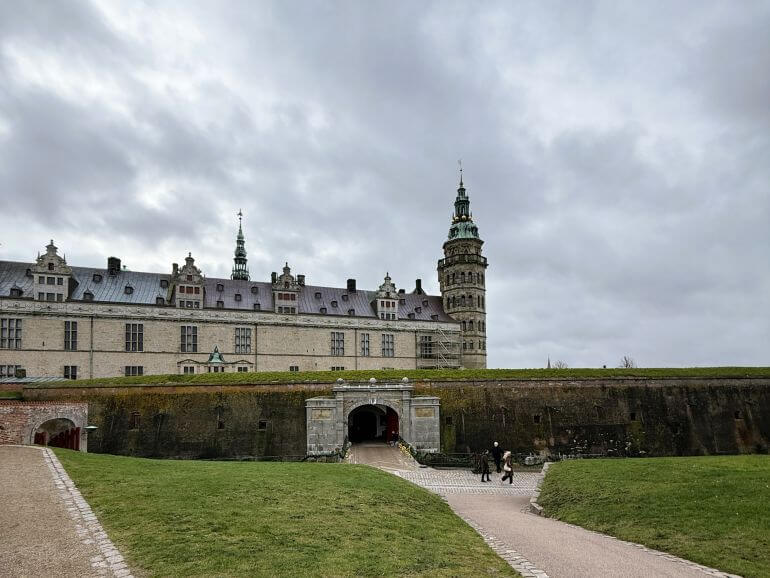
Kronborg Castle in Helsingør, Denmark
Kronborg was the most modern and grand of castles at the time of Shakespeare, and when word of Kronborg had spread to London Shakespeare was inspired to use it as the setting for Hamlet (written about 1600). The castle’s damp, dark, and gloomy underground passages fit the play’s mood as well.
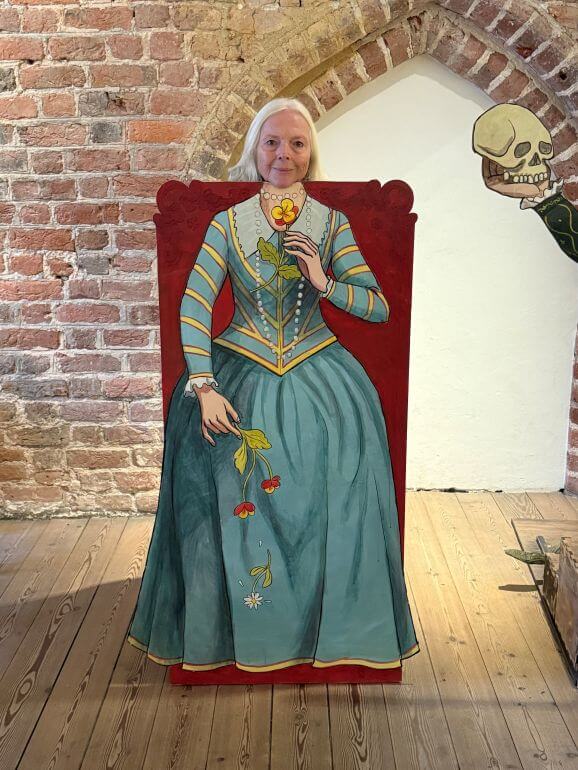
Queen for about a minute at Kronborg Castle
Today, many events take place in the castle (such as plays, holiday festivities, and children’s programs). I couldn’t resist a little fun posing with the cutout seen above. You might notice Yorick’s skull sneaking into the photo from the right.
Visitors can tour many rooms of the castle including the Cannon Bastion, the Queen’s Chamber, the chapel, the great hall, and the kitchen.
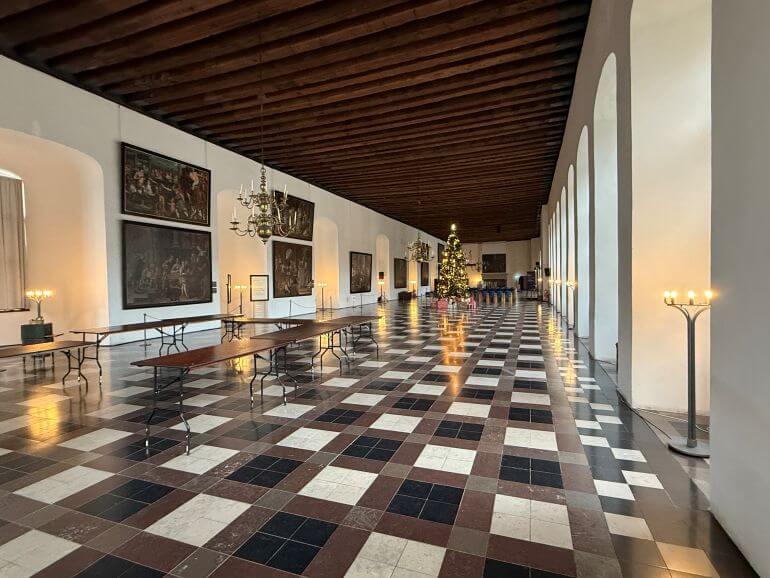
Knight’s Hall at Kronborg Castle
The Great Ballroom (or Knights Hall) at Kronborg Castle goes back to 1582. At almost 63 meters long it is the longest hall in Europe. In the photo above you can see the Swedish marble that makes up the floor and the large historical paintings dating from 1618 and 1631.
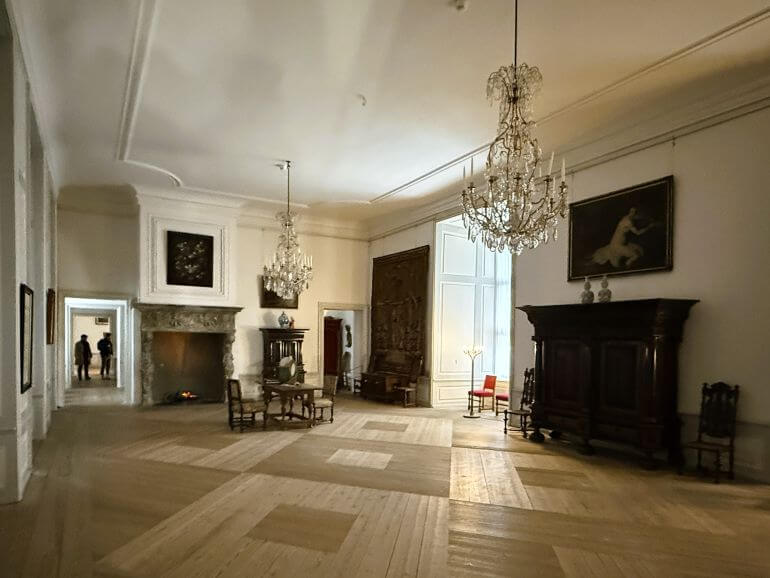
Kronborg Castle
The photo above shows one of King Christian IV’s private rooms. The original interior is simply furnished with historical artifacts.
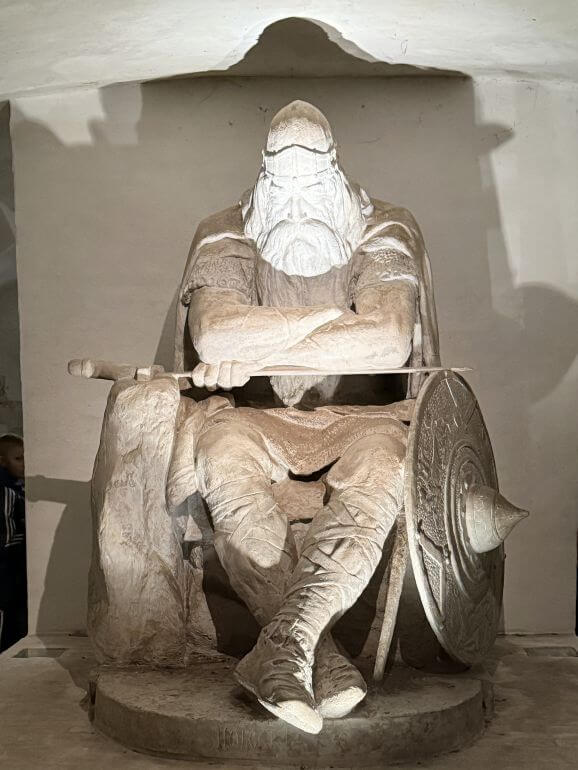
Statue of Holger the Dane at Kronborg Castle
An imposing statue (actually a cast of the original sculpture) of a sleeping Holger the Dane, one of the twelve knights of Charlemagne, by Hans Peder Pedersen-Dan is in the tunnels underneath the castle (casemates). Legend says that one day Holger will awaken at a time when Denmark faces a serious threat. He will then rise, take his sword, and defend the country.
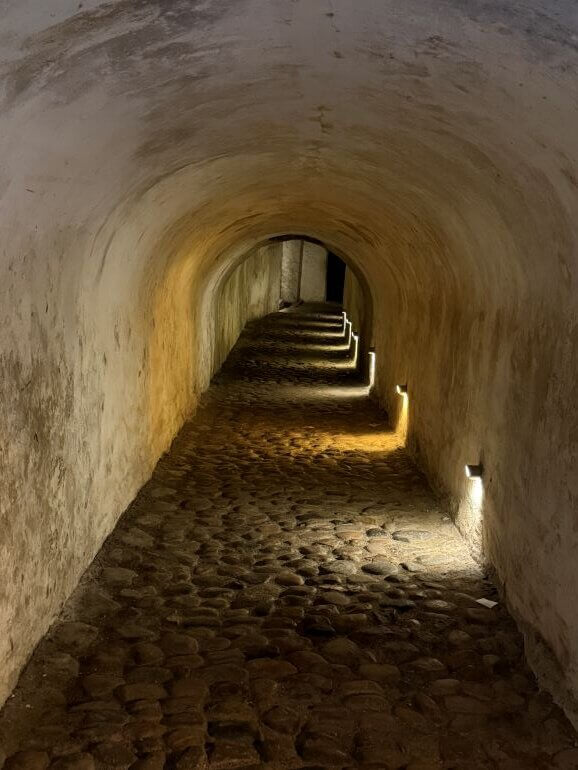
Casemates of Kronborg Castle
From the statue at the entrance and beyond the tunnel section seen above, the environment gets darker. I was a little apprehensive as Mr. TWS and I walked further into the dark dungeon by ourselves, navigating through the narrow tunnel that seemed like a maze sometimes. I was quite relieved when I saw light leading to the outside. We learned from an employee of the castle that each morning there is a staff member who goes into the casemates in the dark and lights the lamps along the way.
From Denmark to Sweden
From the port of Helsingør, we traveled by ferry across the narrowest point of Øresund (commonly known as the Sound) to the port of Helsingborg, Sweden and then went on by coach to explore two Swedish cities — Lund and Malmö.
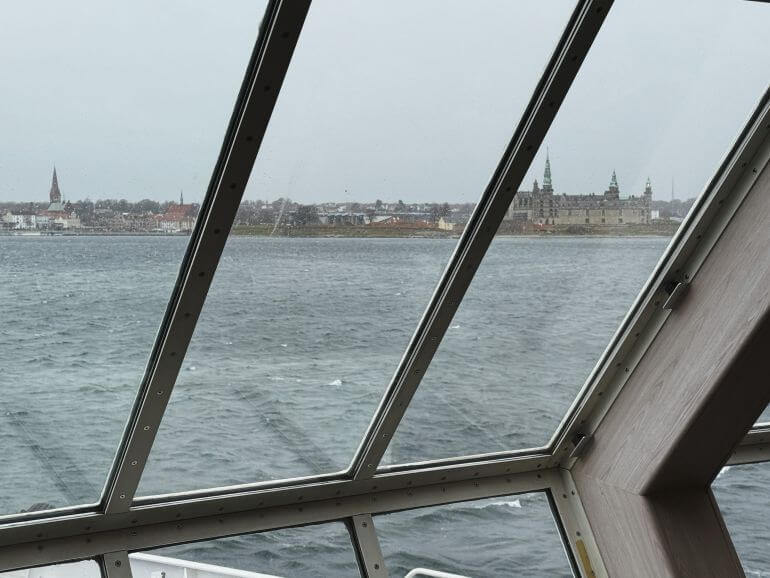
View of Helsingor, Denmark from the car ferry across the Øresund strait (the Sound) to Sweden
We had a short, but enjoyable introduction to Sweden (land of my maternal ancestors) during a Viking cruise on the Baltic several years ago, so we were delighted to have a chance to see a bit more on this day trip.
Lund, Sweden
At almost 1,000 years old, Lund is one of Sweden’s oldest cities. It is a bustling university town and is considered to be a cultural and historical center. It’s a lovely place to walk around to admire Swedish design, learn some history, and visit the cathedral.
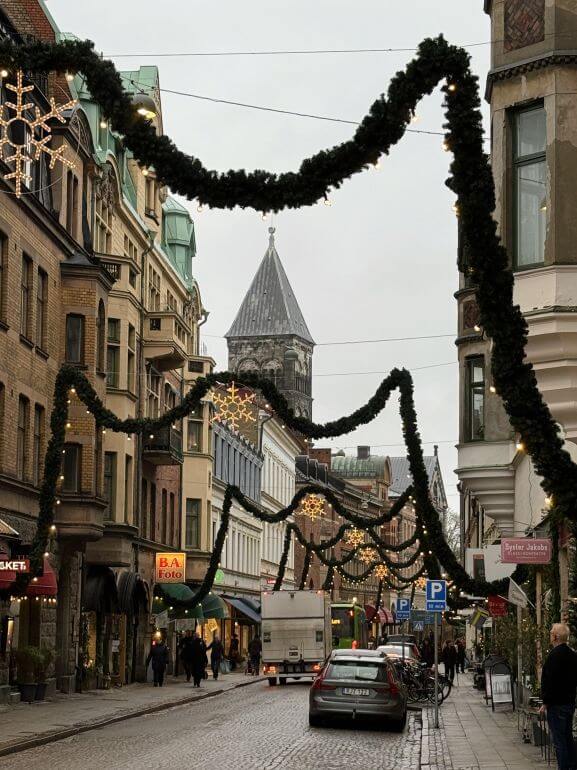
Lund, Sweden
Lund Cathedral, consecrated in the 12th century is a landmark attraction in the city. Be sure to check out the astronomical clock (still in working order), crypt, and choir stalls.
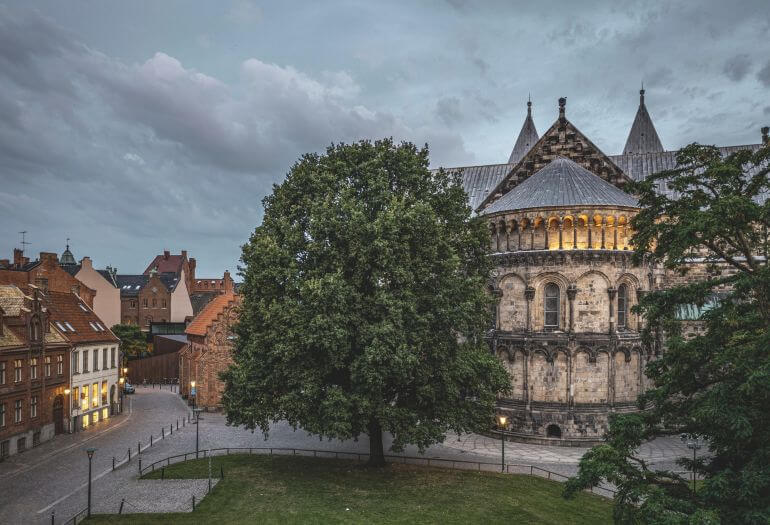
Lund Cathedral – Photo credit: Per Pixel Petersson/imagebank.sweden.se
We enjoyed strolling through the narrow streets and areas with shops and restaurants, such as the charming passageway shown below connecting two major streets.
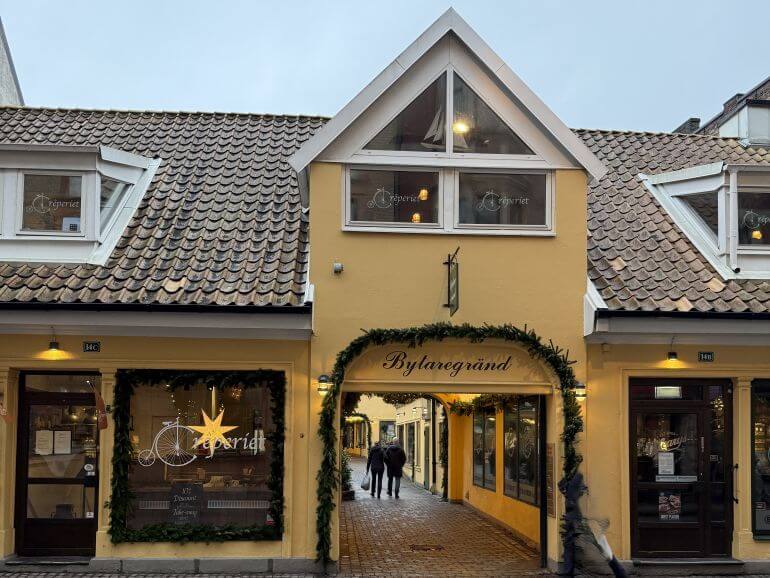
Entrance to Bytaregrand shops and offices in Lund
We took time to have lunch at the upscale Grand Hotel that exuded a warm, elegant, and festive ambiance. The building with a red dome across the street from the hotel typifies Swedish architecture.
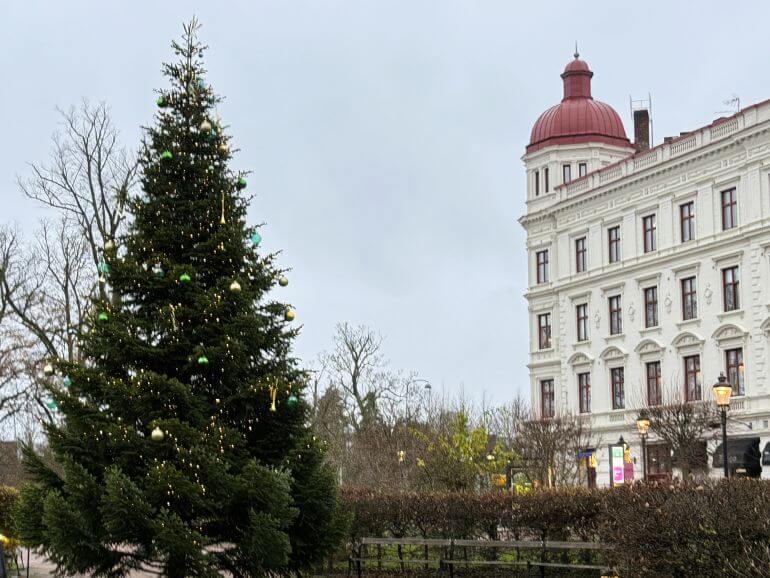
Christmas decorations on tree at Grand Hotel in Lund
Malmö, Sweden
Before venturing into Malmö’s city center, we stopped for a photo op at an architectural landmark. Turning Torso is a captivating residential skyscraper that you can’t miss when you’re come into the city. The structure was designed by Spanish architect Santiago Calatrava who has created other stunning designs such as the Quadracci Pavilion of the Milwaukee Art Museum and the City of Arts and Sciences in Valencia, Spain. It’s quite impressive with 54 stories and a height of 620 ft.
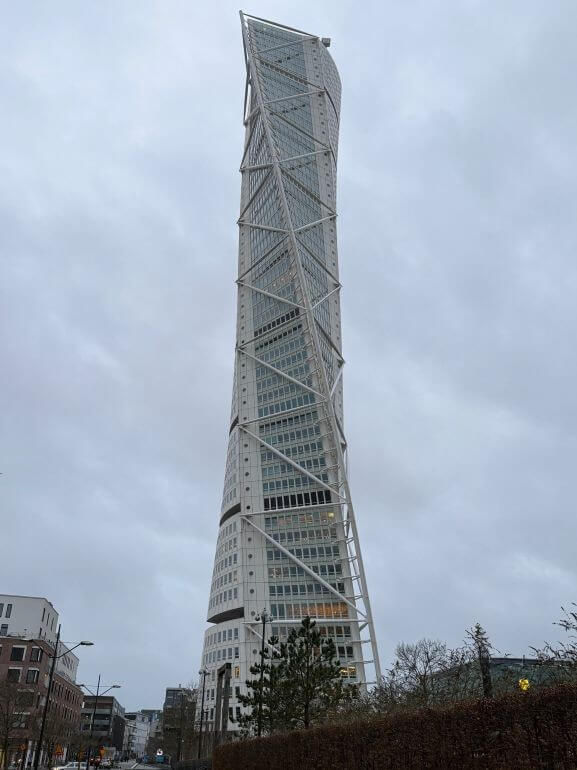
Turning Torso residential building in Malmo
Although we only spent a couple of hours in Malmö, we loved its charm, vibrance, public art, and architecture. The sculpture in the photo below is called Optimistorkestern (The Optimist Orchestra) and was installed to mark the opening of the pedestrianized Södergatan Street in 1985.
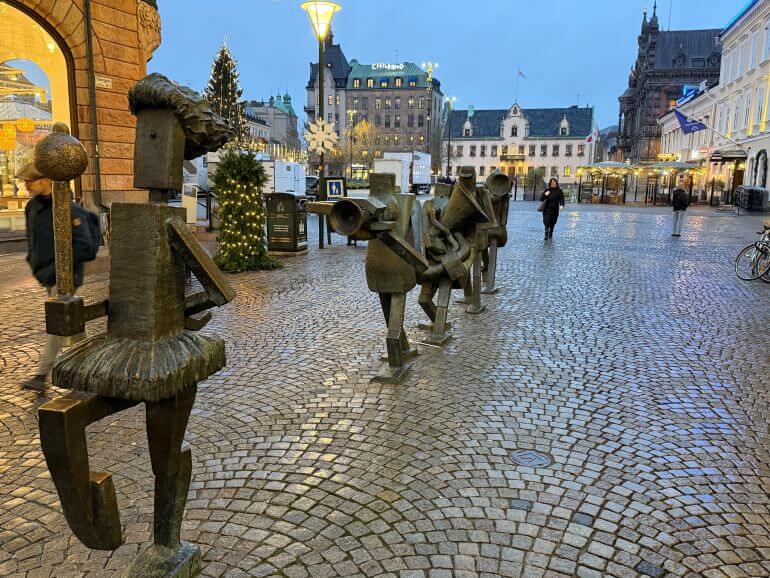
The Optimist Orchestra sculpture in Malmö
While we walked around the city center adorned with holiday lights, I thought about my maternal ancestors from Sweden and wished that my mother had been able to visit. I believe there are still relatives I’ve never met who live in this area. Perhaps someday I’ll be back to explore the family ties.
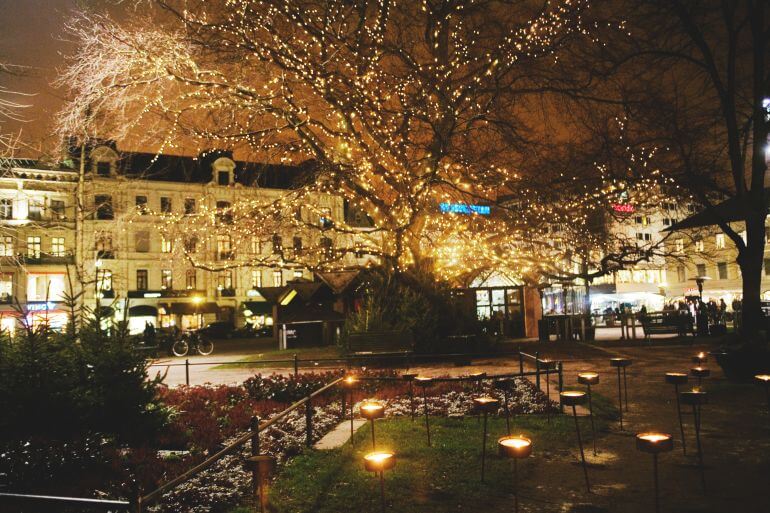
The square of Gustav Adolf in Malmö, Sweden – Photo credit: Miriam Preis/imagebanksweden.se
The square of Gustav Adolf shown above is surrounded by captivating buildings with businesses, shops, and residences.
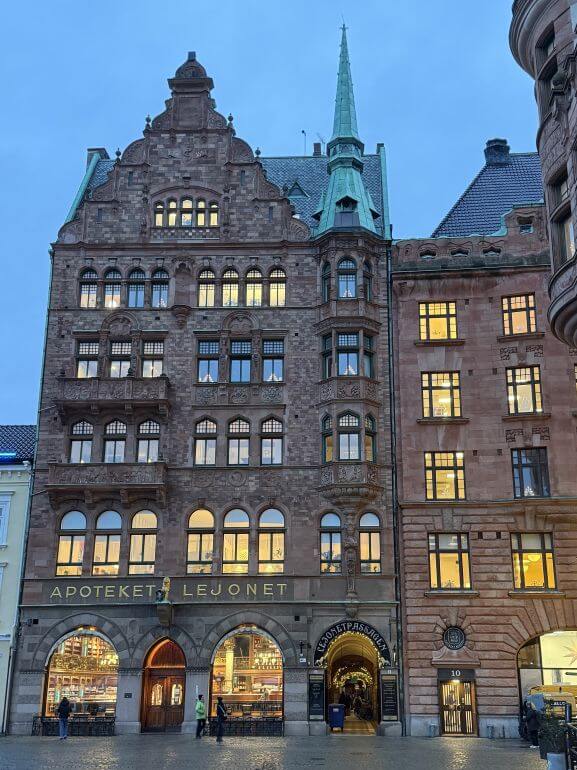
Apoteket Lejonet
One of the distinguished old buildings on Gustav Adolf square on a corner of Stortorget is Apoteket Lejonet, the city’s oldest pharmacy. It opened in 1897 and is one of four pharmacies in Sweden designated as a “monument” having cultural and historical value.
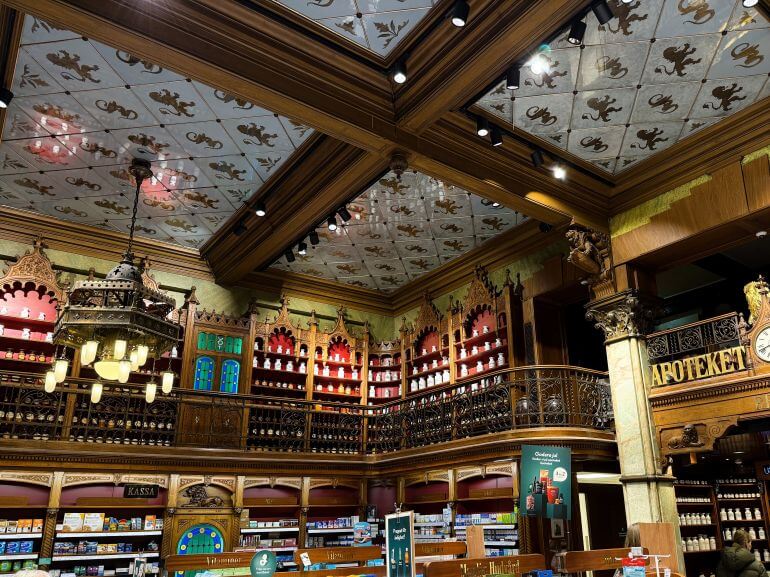
Interior of Apoteket Lejonet in Malmö
It’s worth a visit to Apoteket Lejonet to admire the beautiful 19th century art nouveau interior with a glass-plated ceiling and wood-carved shelves.
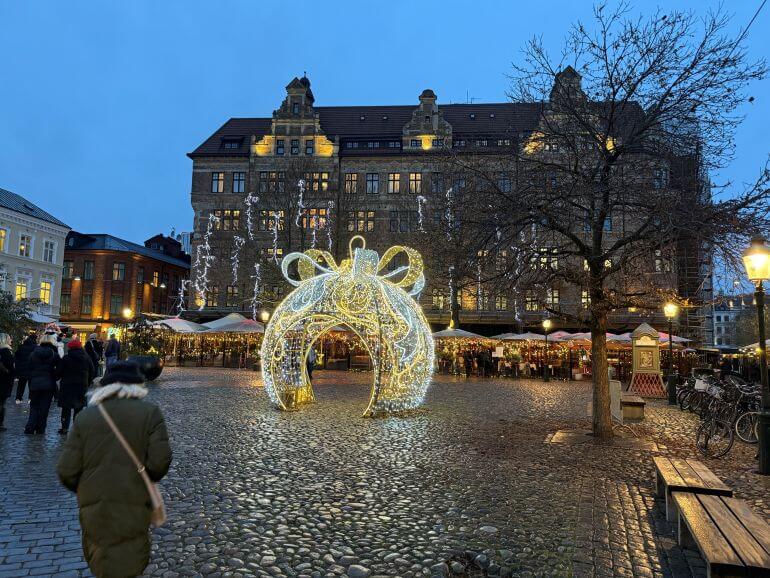
Christmas decoration on Lilla Torg in Malmö
A nice ending to our time in Malmö was enjoying a glass of wine with a view of Lilla Torg (torg means square) at one of the restaurants on the square.
Back to Copenhagen
We really enjoyed this tour and especially at Christmastime. Then it was time to head back to irresistible Copenhagen by way of the Øresund Bridge across the Sound. It was opened in 2000 and accommodates vehicles and trains between Copenhagen and Malmö — a distance of 15.9 km.

Øresund Bridge – Photo credit: Janus Langhorn/imagebank.sweden.se